Maulana Abul Kalam Azad 1888 — 1958

A nation divided

Partition & the Idea of India

A careful account of the division of India in 1947, the arguments Azad made against it, and what he said to those who stayed.

Cabinet Mission
1946
Partition
15 August 1947
Chapter
07 of 08

This page describes a period in which a very large number of people were killed and many millions were displaced. It is written carefully, without images of violence, and without treating a contested history as though it were simple.

Partition is not a subject on which historians agree, and it is not a subject on which this site will pretend to adjudicate. What can be stated with confidence is what Maulana Azad argued, when he argued it, and what he said afterwards. That is what follows.

One

The question that would not resolve

The constitutional question in India from the 1930s onwards was not only when the British would leave. It was what would follow: what kind of state, with what guarantees, for a population divided by religion, language and region in ways that no single federal formula obviously satisfied.

The Muslim League’s answer, formalised in the Lahore Resolution of March 1940, was that Indian Muslims constituted a nation and required their own state. The Congress’s answer, which Azad articulated at length in his Ramgarh presidential address days earlier, was that India was a single nation containing many communities, and that minority anxieties should be met by constitutional guarantee rather than by division.

Between 1940 and 1946 these two positions hardened. Every failed negotiation — the Cripps Mission of 1942, the Simla conference of 1945 — strengthened the case of those who argued that agreement was impossible, and weakened the case of those, like Azad, who argued that it was not.
Two

The Cabinet Mission, 1946

In 1946 a British Cabinet Mission came to India with a proposal designed to avoid partition. Its plan of 16 May envisaged a federal union with a weak centre responsible for defence, foreign affairs and communications, and provinces grouped in a way that gave Muslim-majority regions substantial autonomy within a single country.

Azad, leading the Congress delegation, supported it. It offered the substance of what the demand for a separate state was said to require — security and self-government for Muslim-majority provinces — without dividing the country, and it is the formula he considered the best available.

The plan did not hold. The two parties interpreted the grouping provisions differently, the interim government proved difficult to form, and by late 1946 public order in several provinces had deteriorated severely. Historians continue to disagree about whether the plan was ever workable and about where responsibility for its failure lies. That disagreement is genuine and this site does not resolve it.

Three

1947

In early 1947 the British government announced a date for transfer of power, later brought forward. The plan finally adopted divided British India into two dominions, with Bengal and Punjab themselves partitioned. The All India Congress Committee accepted the plan in June 1947; available accounts record that Azad abstained rather than vote for it.

Independence came on 15 August 1947. So did the boundary. The movement of population across the new borders, and the violence that accompanied it, are among the largest such events in recorded history. Estimates of the numbers killed vary very widely between historians, and figures should be treated with corresponding caution; the scale of displacement runs into many millions.

Azad had opposed the division consistently for seven years and had been, for six of them, president of the organisation that accepted it. That is a difficult position to be in, and he did not pretend otherwise afterwards.

“I do not ask you to seek certificates from the new echelons of power … rest assured, that if you do not wish to flee from this scene, nobody can make you flee.”

Address at the Jama Masjid, Delhi, 23 October 1947 — from widely published English translations

Four

What he said to those who stayed

On 23 October 1947, two months after independence, Azad spoke from the Jama Masjid in Delhi to Muslims who had remained in India, many of them frightened and many considering leaving. Accounts of the address record two arguments running through it.

The first was historical: that Indian Muslims had been part of the freedom struggle and part of the country’s life for centuries, and that this claim was not cancelled by the events of that year. The second was practical and, in its way, severe: that they should not seek protection through deference to whoever now held power, and that if they chose to stay, no one could compel them to go.

It is a speech that is quoted often and read less often. Its tone is not consoling. It asks something of its audience — self-respect, and the refusal of a supplicant’s position — at a moment when self-respect was expensive.

Five

The idea of India, afterwards

Azad’s conception of India did not end with Partition; it was written into the arrangements that followed. The Constitution adopted in 1949 established a secular republic with equal citizenship, guaranteed fundamental rights, and no state religion. Azad served in the Constituent Assembly throughout its work, and in the cabinet of the government that implemented the result.

He then spent eleven years on the part of the project he considered most durable: the education system. It is a reasonable reading of his last decade that he regarded schools, universities, laboratories and academies as the instruments through which the argument he had lost in 1947 could still, over a long enough period, be won.

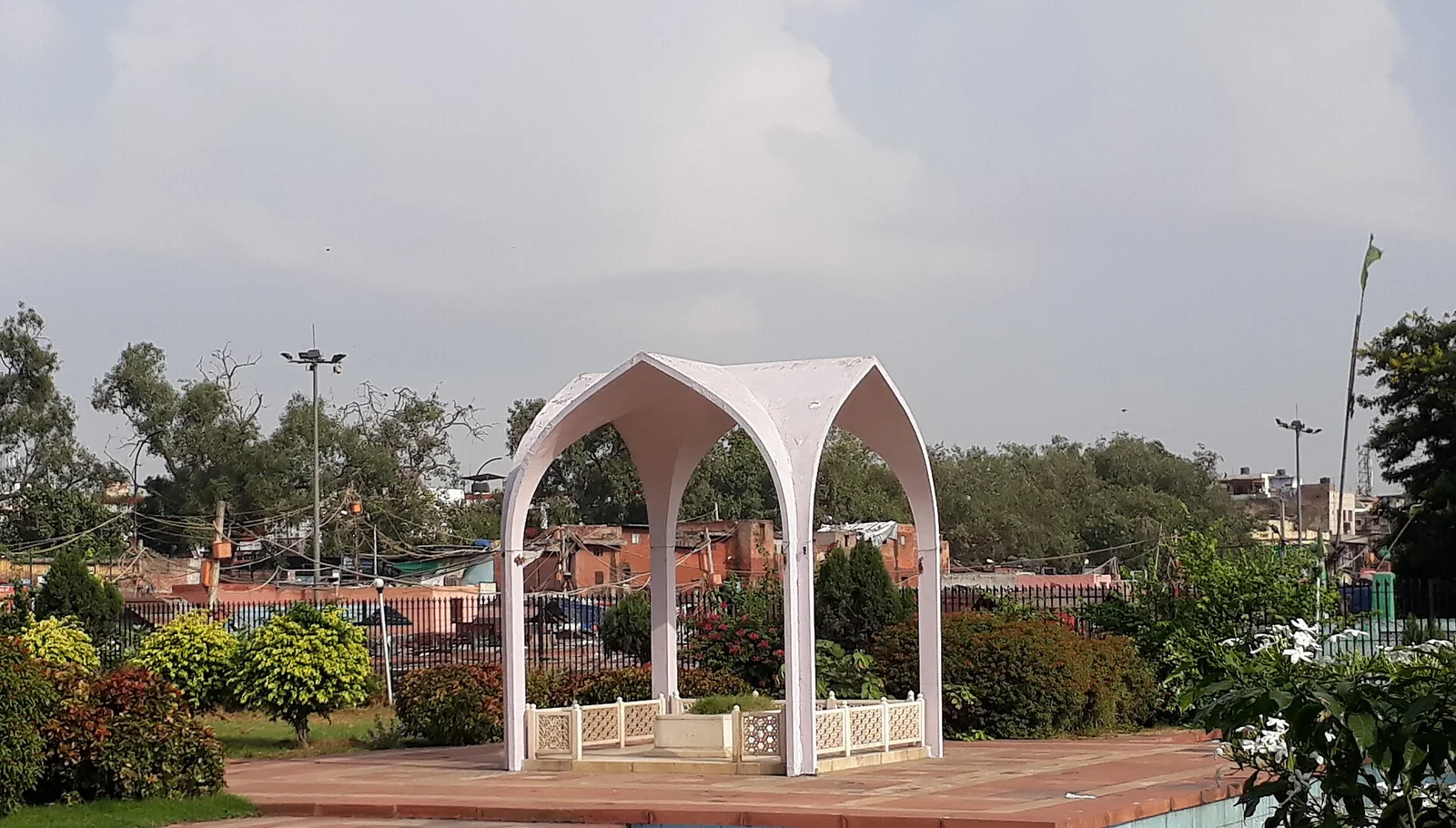
The white arched canopy over the tomb of Maulana Abul Kalam Azad in a landscaped enclosure in Old Delhi, near the Jama Masjid.
MemorialThe tomb of Maulana Abul Kalam Azad in Old Delhi, near Chandni Chowk and the Jama Masjid.

How this page treats disputed history

Published estimates of deaths during Partition differ by an order of magnitude between reputable historians, and the underlying records are incomplete. Quoting a single number would present a contested estimate as an established fact. The scale is described instead in terms that the evidence supports.

The question of who was responsible for Partition — the League, the Congress, the departing colonial administration, or the structure of the situation itself — is one of the most actively debated in modern South Asian history. Azad offered his own answer in India Wins Freedom, and other participants disputed it. This site reports the positions rather than adjudicating between them.

This site is intended to be usable by school students. Photographs of atrocity are widely available in archives and in scholarly publications for those who need them; reproducing them here would add nothing to the historical account and would make the page unsuitable for a large part of its audience.

It is an important first-hand account by a central participant, and it is also, unavoidably, a partisan one. Azad wrote it with knowledge of the outcome and with views about his colleagues’ conduct. Thirty pages he considered too personal for immediate publication were withheld until 1988. Historians use the book extensively and read it critically, which is the right approach for any reader.

More on India Wins Freedom and its publication history.

A note on tone Partition remains within living memory for some families and is politically charged in the present. This page has been written to describe events and positions accurately, to mark what is disputed, and to avoid language that assigns collective blame to any community.