Maulana Abul Kalam Azad 1888 — 1958

Building

Institutions & Nation Building

The UGC, the IITs, the ICCR and the national academies — what the record actually supports about his part in each, stated precisely.

Period
1947 — 1958
Scope
Higher, technical, scientific & cultural
Approach
Historically precise attribution

Bodies established, inaugurated or led during his tenure

Building the infrastructure of knowledge.

Institutions are built by many people: committees that recommend, legislatures that legislate, officials who administer, and academics who staff them. This page sets out what the record supports about Maulana Azad’s part in each — founding president, inaugurating minister, or minister in office — and does not claim more than that.

How to read this page

Precise language, deliberately.

  • Founded

    Established with Azad in a formal founding role — used here only for the ICCR, of which he was founding president.

  • Inaugurated

    Formally opened by Azad as Education Minister, with the body itself created by government decision or statute.

  • Established under his ministry

    Created during his tenure, on the recommendation of committees, with his ministry responsible for carrying it through.

  • Predates his ministry

    Already in existence before 1947; his ministry worked with or through it rather than creating it.

Institutions

  • 1950

    9 April

    Indian Council for Cultural Relations

    Founded in April 1950 to manage India’s cultural relations with the rest of the world. Maulana Azad was its founding president. The ICCR continues to run cultural exchange, scholarships for international students and Indian cultural centres abroad.

    Founding president
  • 1951

    Kharagpur

    Indian Institute of Technology, Kharagpur

    The first IIT, established in 1951 during Azad’s tenure, following the recommendation of a committee appointed to consider higher technical education for the country. It became the template for the national network of IITs that followed.

    Established under his ministry
  • 1952

    Resolution; inaugurated 1953

    Sangeet Natak Akademi

    India’s national academy for music, dance and drama, established by a government resolution in 1952 by the ministry Azad headed, and inaugurated the following year. It remains the country’s principal body for the performing arts.

    Established under his ministry
  • 1953

    28 December

    University Grants Commission

    Formally inaugurated by Maulana Azad on 28 December 1953 to coordinate university education and maintain standards across institutions. It was given statutory status by an Act of Parliament in 1956 and remains the apex body in Indian higher education.

    Inaugurated by Azad
  • 1954

    12 March

    Sahitya Akademi

    India’s national academy of letters, inaugurated on 12 March 1954. It supports literature in the languages it recognises through awards, translation, publication and archives — a direct expression of Azad’s view that a plural literary culture is national infrastructure.

    Established under his ministry
  • 1954

    5 August

    Lalit Kala Akademi

    India’s national academy of fine arts, inaugurated on 5 August 1954 by Maulana Azad as Minister for Education. It supports the visual arts through exhibitions, publications, studios and national awards.

    Inaugurated by Azad
  • 1945

    Predates independence

    All India Council for Technical Education

    AICTE was set up in November 1945 as a national advisory body on technical education, before independence, and was given statutory status by an Act of Parliament in 1987. It operated within Azad’s ministry through the expansion of technical education in the 1950s.

    Predates his ministry · worked through it
  • 1920

    October

    Jamia Millia Islamia

    Founded in 1920 as a nationalist educational institution outside the colonial system. Azad was a member of its foundation committee in October 1920 — twenty-seven years before he became a minister, and a useful indication of how early his interest in institution-building began.

    Foundation committee member
  • 1947–58

    Across the tenure

    Central education machinery

    Beyond the named bodies, the period saw the construction of the routine machinery a national education system needs: commissions on university and secondary education, teacher-training institutions, and the beginnings of a central apparatus for standards and funding.

    Minister in office

The pattern

What the list actually shows

Read together, the institutions of these eleven years describe a single strategy. Technical and scientific capacity at the top end — the IITs, the expansion of technical education. Coordination and standards in the middle — the UGC. Cultural confidence and international presence at the edges — the academies and the ICCR.

What the strategy assumes is that a poor country cannot afford to build only what is immediately useful. Azad’s ministry funded academies for poetry and painting in the same decade that it was struggling to get children into primary schools, and the justification offered was not sentimental: a nation that cannot maintain its own cultural life will not have the confidence to do anything else well.

The record also shows what he did not do. He did not create the technical education council; it already existed. He did not personally found most of these bodies; committees recommended them and governments established them. His part was to argue for them, to carry them through a cabinet with very little money, and to open them.

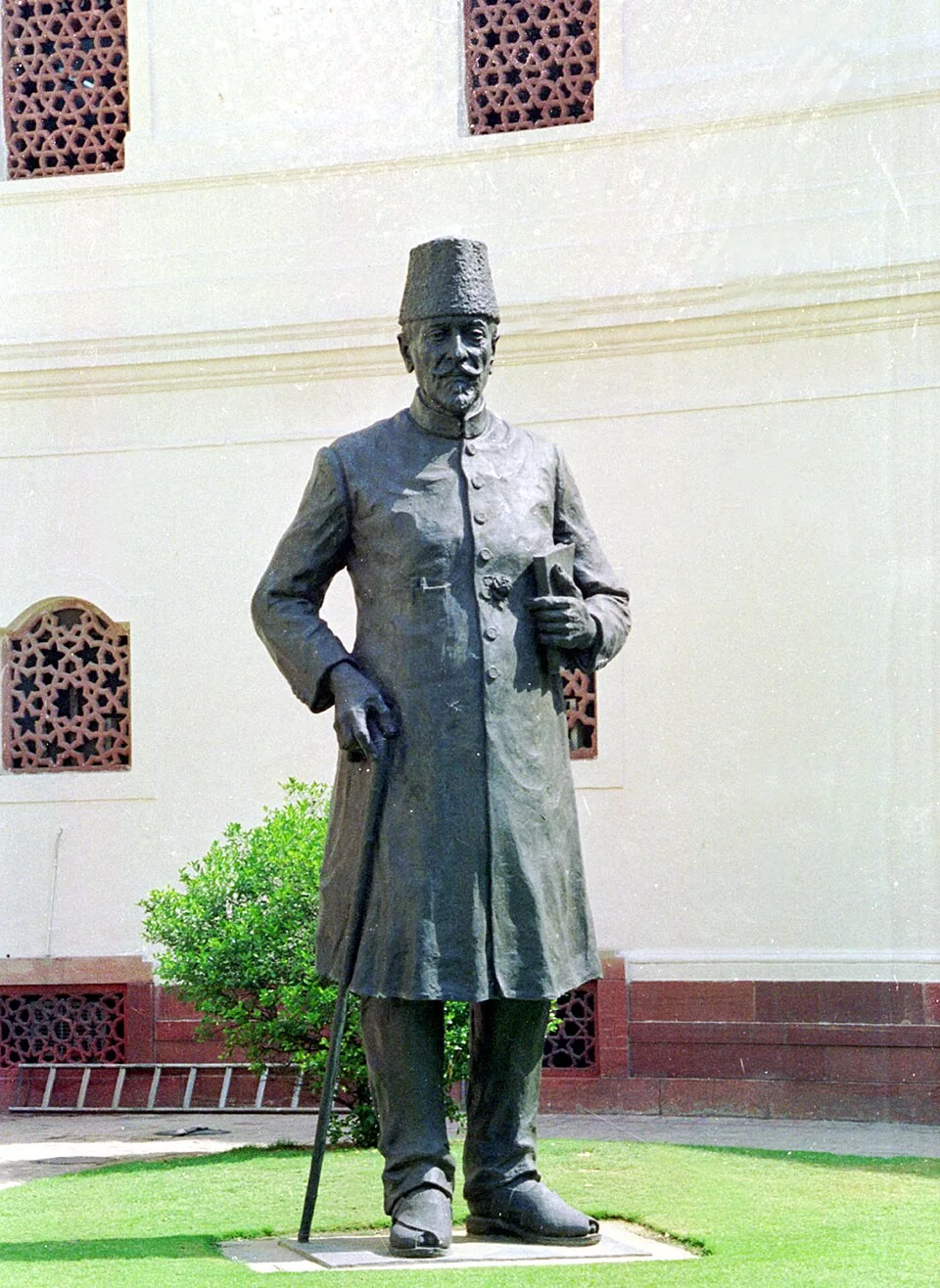
Bronze statue of Maulana Abul Kalam Azad holding a book and a walking stick, standing in the Parliament complex, New Delhi.
MemorialStatue in the Parliament complex, New Delhi. Photographed 23 March 2005.
A note on institutional claims Founding dates and Azad’s specific role have been taken from the institutions’ own published records and from government sources. Where a body predates 1947 or was established by committee recommendation rather than ministerial initiative, this page says so explicitly rather than absorbing it into a general claim of authorship.